
Dynamic formation of invariant object representations
PI: Alan Stocker
Co-PI: Xaq Pitkow, CMU; Josh Gold, UPenn,


Abstract
Interacting effectively with the world requires the ability to build, maintain, and update invariant representations of the objects that are encountered. Progress to date on understanding object representations in biological and artificial systems has focused mainly on static sensory information (e.g., briefly presented images; Yamins/DiCarlo 2016). However, in the real world the sensory information we receive about a given object changes constantly. We hypothesize that accounting for this constant change in sensory input is essential for the formation of invariant (robust) object representations. Our goals for this collaborative project are: 1) to develop new approaches to study quantitatively how object representations are formed and evolve in dynamic environments, 2) to use these approaches to understand dynamic object representations in biological systems, and 3) to develop and test novel dynamic artificial neural network models of object representation.
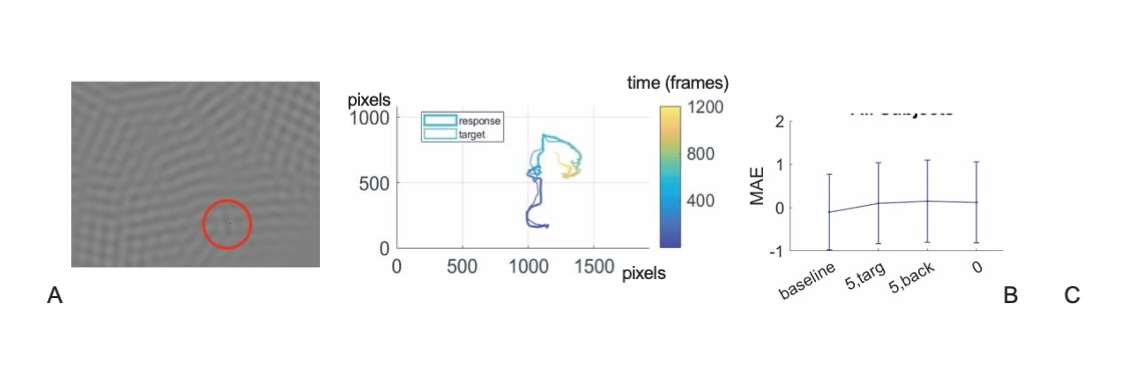
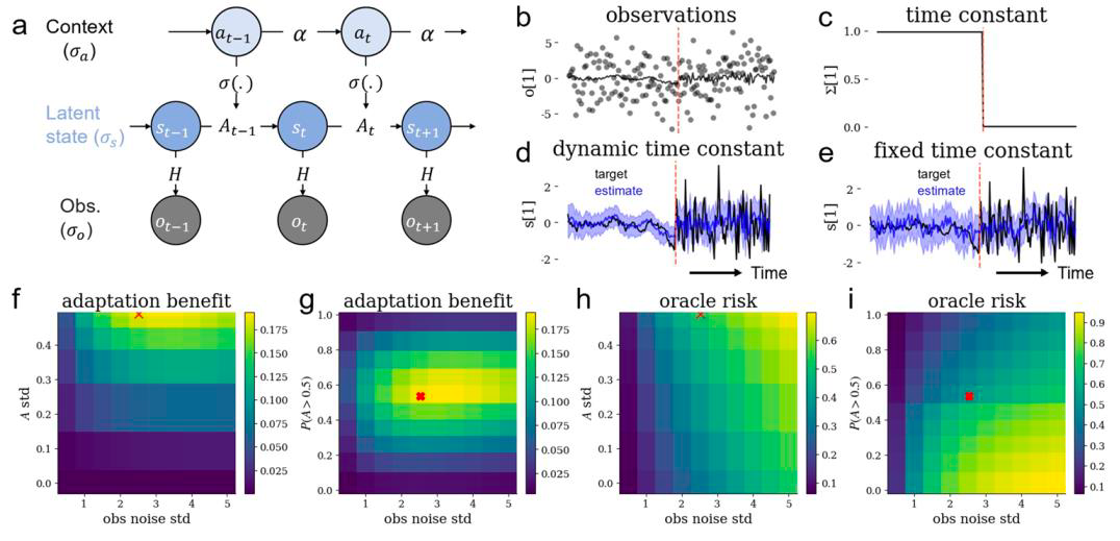
Figure 1: Continuous tracking task and corresponding state-space model for studying adaptation. (A) Screenshot showing the Gabor target (circled for clarity; the actual task does not show the circle) in a field of larger Gabor distractors. The task requires the participant to track the movement of the target using a mouse, with or without pre-exposure to the target to induce adaptation. (B) A single representative tracking trace from one participant in one trial. (C) Average tracking error across different adaptation conditions and participants. There is a slight trend suggesting that adaptation leads to better tracking performance but it is not significant. (D) Statespace model to study adaptation. It is a hierarchical model where contextual dynamics affect the latent state dynamics. (E, F) Model observations across a contextual change. (G,H) Latent state and the estimate of an observer with optimal adaptation (latent and context dynamics). (I-L) Systematic analysis of the relative adaptation benefits as a function of different latent state dynamics and observation noise; relative compared to the intrinsic task difficulty (oracle risk).
Publications
In Progress
Resources
In Progress